Labels
Pressure-sensitive — paper · BOPP · PE — direct thermal · thermal transfer
Labels are cheap per piece and expensive when they're wrong. A label that peels off in a freezer, fades in a warehouse, or won't fit the applicator costs far more than the labels themselves.
Most of the labels I source are pressure-sensitive: a face stock, an adhesive and a release liner, delivered on a roll. The spec is mostly about what the label sticks to, where it lives, and what prints on it.
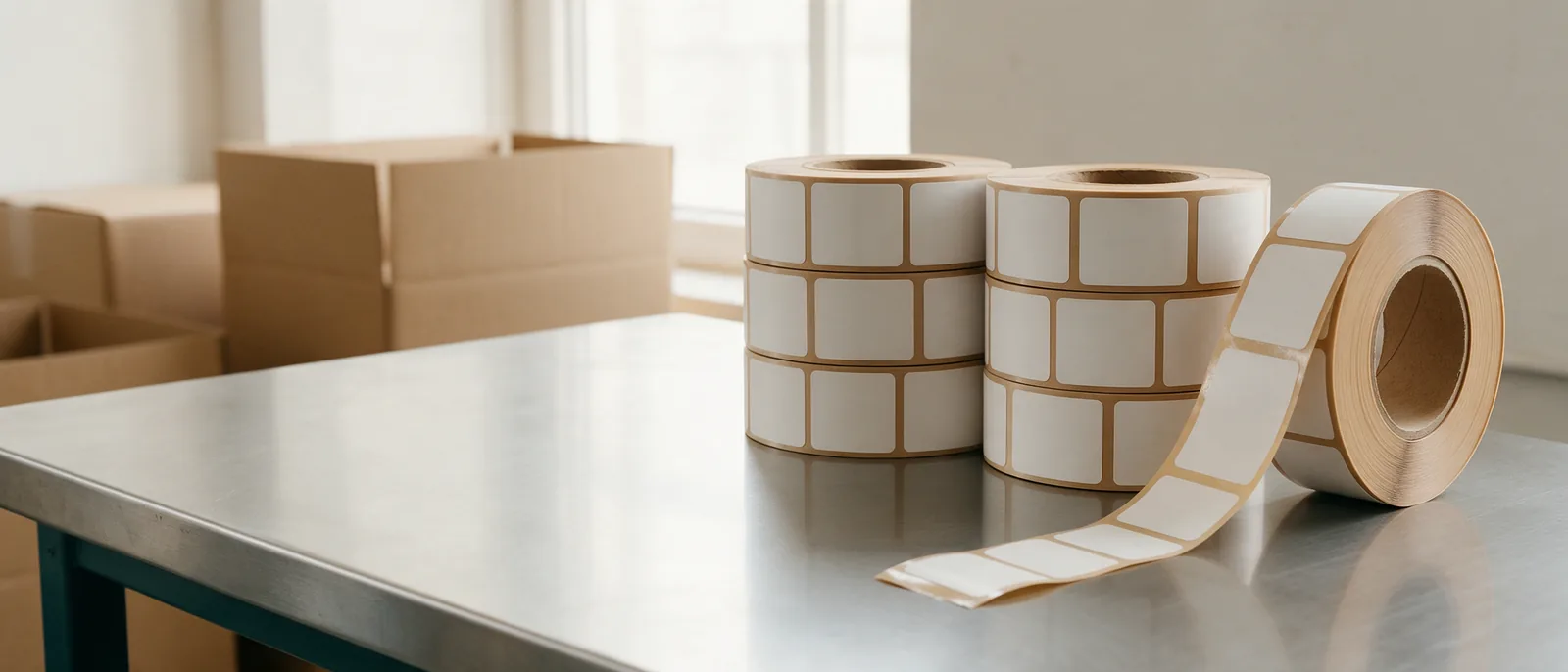
Face stock, adhesive, liner.
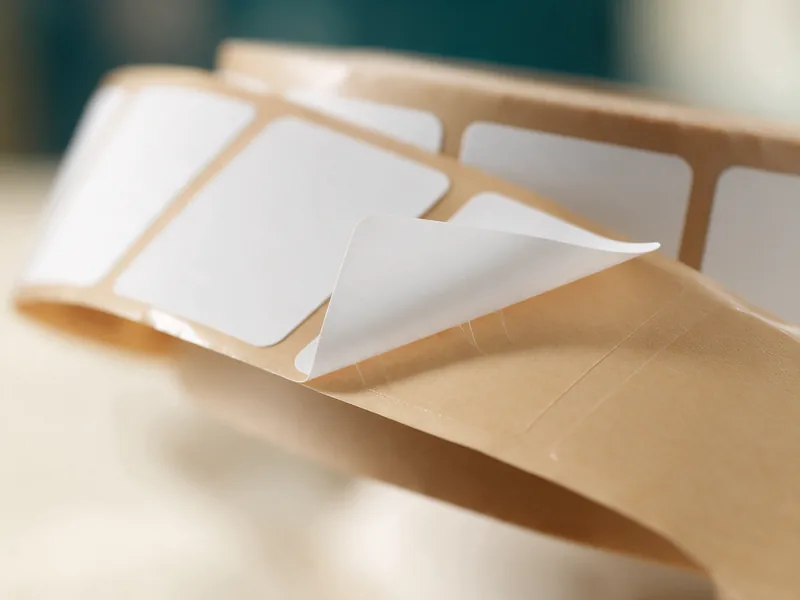
A pressure-sensitive label is a sandwich: the face stock you print on, an adhesive that sticks when pressed, and a silicone-coated release liner that carries the label until it's applied. Labels are die-cut through the face and adhesive, the waste matrix is stripped away, and the finished labels are wound onto rolls.
They cover two broad jobs: prime labels printed with branding and product information, and blank or variable-information labels that get printed on demand — shipping labels, case labels, lot codes and barcodes.
Use it when
- You need branding or regulatory information on a container, case or bag.
- You print barcodes, lot codes or shipping information on demand.
- You apply by hand, with a desktop printer, or with a print-and-apply system.
- The container shape or volume doesn't justify direct printing.
What goes on a label spec.
- Face stock
- Paper (uncoated, semi-gloss, direct thermal, thermal transfer) or film. BOPP resists moisture and oil and is common for food, beverage and personal care. PE is conformable for squeezable containers. PET and vinyl for heat, chemicals and durability.
- Adhesive
- Permanent, removable, freezer-grade (applied and used cold), or high-tack for difficult surfaces such as textured or low-surface-energy plastics, corrugated or dusty bags. Specify both the application temperature and the service temperature.
- Liner
- Usually paper (glassine or kraft). Thin film liners such as PET are used for high-speed application and clear "no-label look" labels.
- Print method
- Direct thermal: heat-sensitive face, no ribbon; simple, but the image can fade with heat, light and time — fine for shipping labels. Thermal transfer: a ribbon (wax, wax/resin or resin) transfers the image; durable for long-life labels. Prime labels are usually flexo or digitally printed by the converter.
- Size and layout
- Width × length (across × around the roll), corner radius, gap between labels, and number across the web.
- Roll specs
- Core inside diameter (commonly 1" for desktop printers and 3" for industrial printers and applicators), maximum roll OD, labels per roll, wound in or wound out, and unwind direction so the copy comes off the roll the right way up.
- Finish
- Varnish or lamination for scuff and moisture resistance; perforations between labels for fanfold or tear-off use.
What drives label cost.
Face stock and adhesive
Film costs more than paper; specialty adhesives (freezer, high-tack) cost more than general-purpose permanent.
Size and layout
Labels are priced by area. A layout that runs more labels across the web makes better use of material and press time.
Print
More colors, process printing and special inks cost more. Varnish or lamination adds a step.
Tooling
A custom die costs money; converters keep many stock die sizes. Choosing a stock size can remove the tooling charge.
Quantity and versions
Setup is spread across the run. Many versions in small quantities are where digital printing earns its keep.
Roll configuration
Small rolls mean more cores, more changeovers on your line, and sometimes more cost per label.
Where label money leaks.
Adhesive that doesn't suit the surface
Labels that lift off cold, wet, textured or low-energy plastic surfaces get reapplied by hand or cause rejected shipments. Test the adhesive on the real container, at the real temperature.
Direct thermal used where it fades
Direct thermal is right for short-life labels. For pallet tags or inventory labels that sit for months or near heat and light, thermal transfer is the safer choice.
Rolls that don't fit the equipment
Wrong core, oversized OD or the wrong wind direction stops a print-and-apply line. Copy the printer's requirements onto the spec.
Custom dies for standard sizes
A label that's a sixteenth of an inch off a stock size often doesn't need to be. Ask before paying for a new die.
Too few labels per roll
On automated applicators, every roll change is downtime. The largest roll the equipment accepts is usually the cheapest to run.
Questions buyers ask me about labels.
What's the difference between direct thermal and thermal transfer?
Direct thermal labels have a heat-sensitive coating that darkens where the printhead heats it; no ribbon is needed, but the image can fade over time with heat and light. Thermal transfer printers use a ribbon to transfer ink onto the label, which produces a more durable image. Direct thermal suits short-life labels like shipping labels; thermal transfer suits long-life and harsh-environment labels.
What does unwind direction mean?
It describes which way the copy faces as the label comes off the roll — top first, bottom first, left or right edge first. Applicators and printers need the labels oriented a specific way, so it belongs on the spec. Converters use numbered unwind charts to make this unambiguous.
What core size do I need?
Use whatever your printer or applicator calls for. Desktop thermal printers commonly use 1" cores; industrial printers and print-and-apply systems commonly use 3" cores. Check the maximum roll diameter too.
Do I need freezer-grade adhesive?
If the label is applied to cold or frozen product, or lives in a freezer, yes. A general-purpose permanent adhesive can lose tack at low temperatures and fall off.
Send me your label spec.
Send me a sample label, what it sticks to and the printer or applicator model. I'll get the face, adhesive and roll specs right before anything gets quoted.
Helpful to include
- What the label goes on (surface material and shape)
- Application and storage temperatures
- Size, shape and number of colors, or a sample label
- How it's printed and applied (printer or applicator model)
- Core size, max roll OD and wind direction
- Quantity per version and number of versions
Related tools
I don't have a label calculator yet. The tools hub has the pallet and freight calculators for the cases your labels go on.