Flexible packaging
Rollstock · Stand-up pouch · Flat pouch — PET/PE · BOPP · foil · EVOH
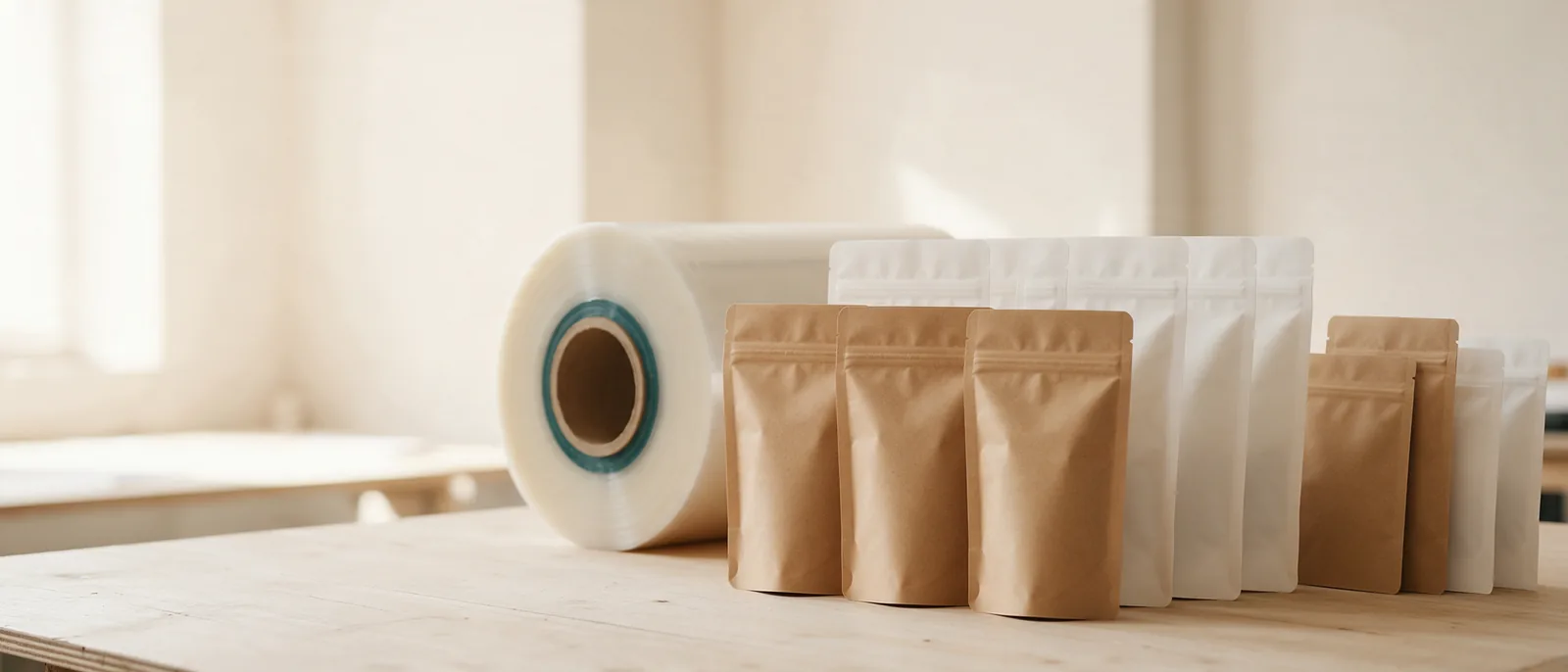
Flexible packaging is film, foil and paper laminated together, then either sold to you as a finished pouch or as a printed roll that your machine forms, fills and seals. Same materials, very different economics.
The spec starts with the product, not the pouch: what it needs protecting from, for how long, and what it's filled on. Once that's clear the structure usually follows. When it isn't clear, people tend to buy more barrier than the product needs.
Thin layers, each with a job.
Most flexible packages are laminates: an outer layer that carries the print and gives stiffness and gloss, sometimes a barrier layer that keeps out oxygen, moisture or light, and an inner sealant layer that melts and bonds when the package is heat sealed.
It comes to you in two main forms. Pre-made pouches and bags — stand-up, flat, gusseted — are filled and sealed at the top. Rollstock is printed film on a roll that a vertical or horizontal form-fill-seal machine turns into packages on your line.
Use it when
- Weight and cube matter — flexible packaging uses far less material and space than a rigid container.
- The product needs a specific moisture, oxygen or aroma barrier.
- You run form-fill-seal equipment, or volume is high enough to justify it.
- You want features like reclosable zippers, tear notches, spouts or valves.
How a flexible package gets specified.
- Format
- Rollstock for VFFS/HFFS machines, or pre-made: stand-up pouch (bottom gusset), flat pouch (three-side seal), side-gusset bag, flat-bottom pouch, pillow pack, lidding film.
- Structure
- Layer by layer, outside to inside — for example PET / PE, BOPP / BOPP, PET / foil / PE, PET / metallized PET / PE, or paper / PE. Print is often reverse-printed on the outer film so the ink is buried between layers.
- Barrier
- What the product needs to be protected from. Measured as OTR (oxygen transmission rate) and WVTR (water vapor transmission rate). Foil, metallized films and EVOH are common barrier layers.
- Thickness
- Given per layer and in total, in mils, microns or gauge. 1 mil = 0.001" = 25.4 µm = 100 gauge.
- Dimensions
- Pouches: width × height plus gusset. Rollstock: web width, print repeat length, core inside diameter (commonly 3" or 6"), maximum roll OD or weight, and unwind direction so the print comes off the roll the right way for your machine.
- Features
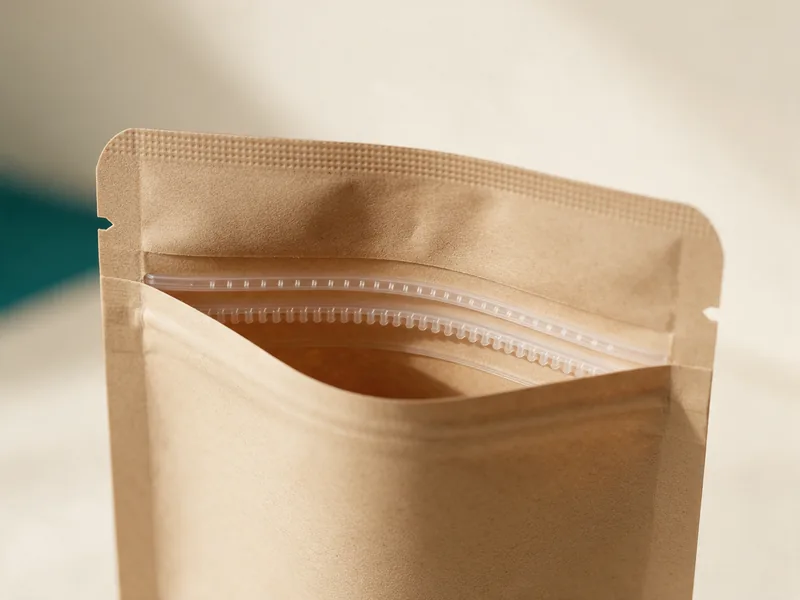
- Press-to-close zippers, tear notches, hang holes, rounded corners, windows, one-way degassing valves (coffee), spouts, laser scoring for easy opening.
- Rotogravure for long runs and top print quality; flexo for a wide range of runs; digital for short runs and many SKUs. Gravure cylinders and flexo plates are one-time costs; digital avoids them.
- Sealing and compliance
- Seal temperature window and equipment, food-contact requirements, and any hot-fill, retort, microwave or freezer conditions.
What drives the price of pouches and film.
Structure
More layers, thicker layers and premium barrier materials such as foil cost more. Each lamination step is another pass through the converting plant.
Pouch vs. rollstock
Pre-made pouches carry the converting cost of forming and sealing each pouch; rollstock moves that step to your machine. At high volume rollstock is usually cheaper per package — but it requires the equipment.
Print method
Gravure cylinders are expensive up front and cheap per impression; digital has no cylinders and a higher per-unit cost. Run length decides which one wins.
Features
Zippers, valves and spouts add material and converting cost to every unit.
Run length and SKUs
Setup and minimums are significant in flexible packaging. Many SKUs at small quantities each get expensive quickly.
Resin and foil markets
Film prices move with polymer and aluminum markets, so quotes are often valid for a limited time.
Where film and pouch spend leaks.
Barrier the product doesn't need
A foil structure on a product that would be fine in a metallized or clear barrier film is a common overspend. Start from required shelf life and storage conditions.
Pre-made pouches past the break-even point
If volume has grown, it's worth checking whether rollstock on form-fill-seal equipment now makes sense. That's a capital decision, so do the math honestly, including labor and changeover.
Separate cylinders for every SKU
Designing a family of SKUs to share common colors or plates — or moving low-volume SKUs to digital — can cut tooling and minimums.
Rolls that don't fit the machine
Wrong core size, oversized OD or the wrong unwind direction stops a line. Put the machine's roll requirements on the spec.
Seal problems blamed on the film
Leaks are often a mismatch between the sealant layer and the machine's temperature, dwell or pressure settings. Check both sides before changing the structure.
Questions buyers ask me about pouches and rollstock.
Should I buy pre-made pouches or rollstock?
If you're filling by hand or on a pouch-filling machine, you need pre-made pouches. If you run vertical or horizontal form-fill-seal equipment, rollstock is usually cheaper per package. For growing products, the break-even depends on volume, labor and equipment cost.
What's the difference between mil, micron and gauge?
They're three units for film thickness. One mil is a thousandth of an inch, which equals 25.4 microns and 100 gauge. So a 48 gauge PET film is 0.48 mil, about 12 microns.
Can flexible packaging be recyclable?
Some can. Mono-material structures, such as all-polyethylene pouches, are designed for recycling streams that accept PE film. Multi-material laminates like PET/foil/PE generally are not recyclable in those streams. Recyclability claims depend on local programs and labeling rules, so they need to be checked for your market.
Why do some pouches have a valve?
One-way degassing valves let gas escape without letting air in. They're common on fresh-roasted coffee, which releases carbon dioxide after packing.
Send me your flexible packaging spec.
Tell me what the product needs and what it runs on. I'll suggest a structure that fits, and tell you plainly if the one you're buying now looks like more than you need.
Helpful to include
- The product, fill weight and how it's filled (by hand, pouch filler, VFFS/HFFS)
- Current structure or a sample, if you have one
- Shelf life and storage conditions (ambient, refrigerated, frozen)
- Pouch dimensions or roll specs (web width, repeat, core, max OD)
- Features: zipper, notch, valve, window
- Number of SKUs and quantity per SKU
Related tools
Pouches and rolls ship in cases on pallets; these tools check that side of the cost.