Multiwall paper bags
Sewn open mouth · Pinch bottom · Pasted valve — 2–4 plies — PE liner / barrier
Multiwall bags are a big part of my background, mostly in industrial food: flour, sugar, starches, ingredient blends. They look simple. They're not, because the bag has to suit the product, the filler and the pallet all at once.
The closure style is decided by your filling equipment. The ply count and paper are decided by the product weight and how rough distribution is. The liner is decided by moisture and grease. Get the order of those decisions right and the rest is detail.
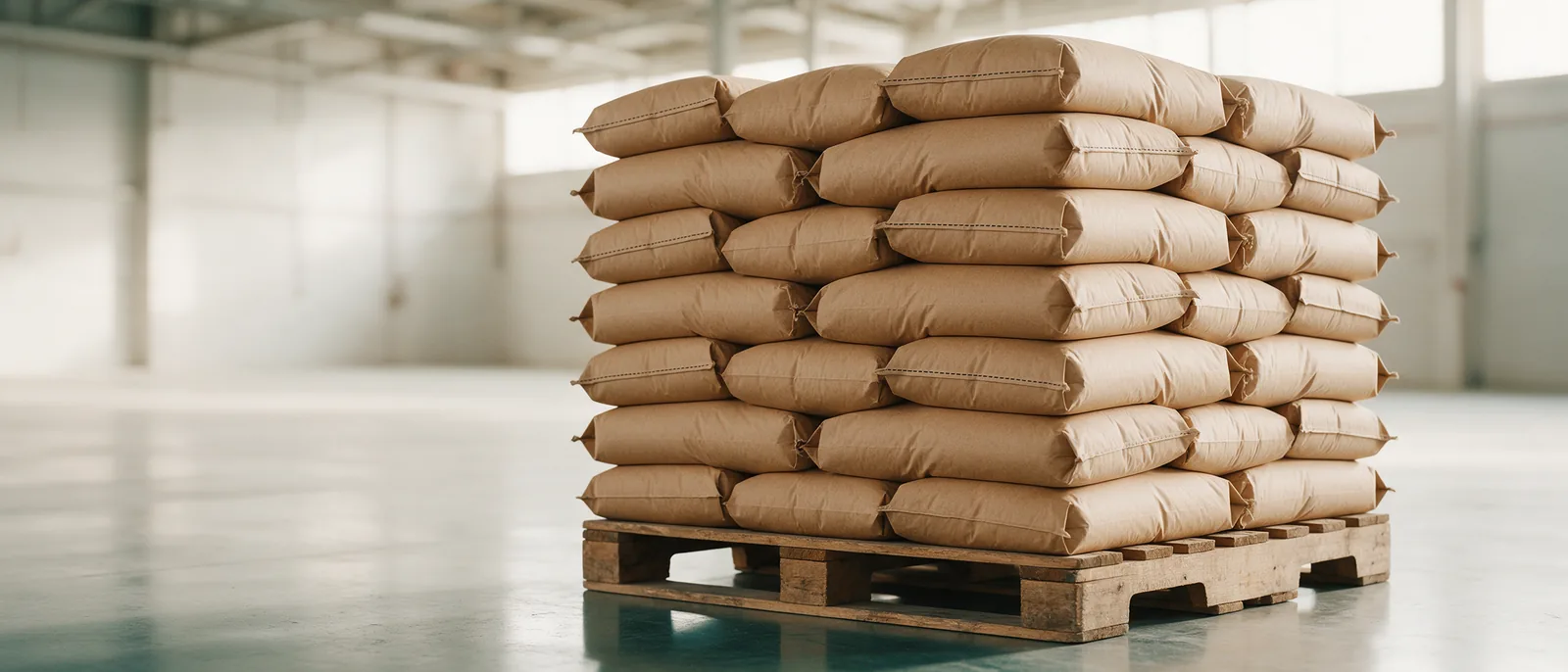
Several layers of kraft paper, made into one bag.
A multiwall bag is a tube of two or more plies of kraft paper, sometimes with a plastic film ply or liner, closed at one or both ends. The plies share the load, so the bag can be strong without one very heavy sheet of paper.
They're the standard package for dry, flowable products sold in roughly 25 to 50 lb units: flour, sugar, animal feed, pet food, seed, lawn and garden products, cement and mortar, minerals, resins and chemicals.
Use it when
- You're packing dry, flowable product in roughly 25 to 50 lb units.
- You want a paper-based package that palletizes well and breathes during filling.
- Your filler is built for open-mouth or valve bags.
- The product needs moisture or grease protection that a liner or coated ply can provide.
What goes on a multiwall bag spec.
- Construction
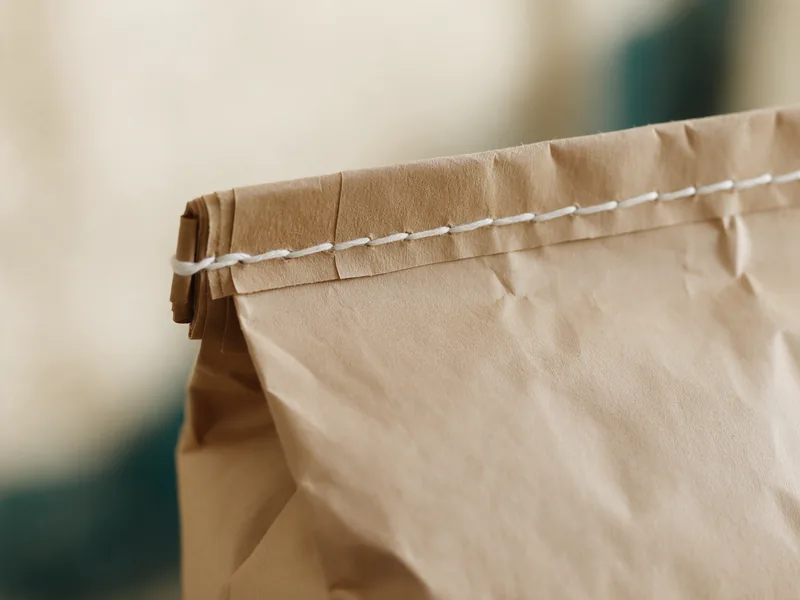
- SOM (sewn open mouth): filled through the open top, then sewn closed, often with tape over the stitching. PBOM (pinch bottom open mouth): ends are stepped and sealed with adhesive instead of stitching — no needle holes, cleaner and more sift-resistant. Pasted valve: closed at both ends and filled through a valve in one corner, which closes under the weight of the product or is sealed. Common for fine powders and high-speed packers.
- Dimensions
- Face width × gusset × length (for example 16 × 5 × 35). For valve bags, the valve size and position matter as much as the bag size.
- Plies and paper
- Number of plies and the basis weight of each, in lb per 3,000 sq ft ream — for example 3 plies of 50# natural kraft. Extensible sack kraft stretches before it tears, which improves drop resistance. Bleached outer plies print brighter.
- Barrier
- A free PE liner, a laminated or coated ply, or a film ply in the wall for moisture or grease resistance. Some products need the bag to breathe; some need it sealed.
- Venting
- Micro-perforations or porous paper let air escape while fine powders fill, so the bag settles and squares up instead of ballooning.
- Valve
- For valve bags: internal or external sleeve, paper or film, and how it closes (self-closing, tuck-in, or heat/ultrasonic sealed).
- Print and finish
- Usually flexo, from one to several colors. Anti-skid coating on the outer ply helps pallet stability.
- Pallet pattern
- Bags per layer and layers per pallet. Interlocking patterns are standard; the bag's filled dimensions have to fit the pallet footprint.
What drives the price of a multiwall bag.
Paper weight and plies
Paper is most of the cost. Each ply and each step up in basis weight adds material to every bag.
Paper grade
Extensible, bleached, wet-strength or high-porosity papers cost more than standard natural kraft — and often let you use fewer plies.
Barrier
Film liners, film plies and coated papers add material and converting steps.
Construction
Valve inserts, pinch-bottom sealing and special features each add converting operations.
Print
More colors and heavier coverage mean more plates and ink.
Size and volume
Bigger bags use more paper; runs are priced with setup spread over quantity.
Where multiwall programs lose money.
Plies added after one bad season
A ply added to stop breakage years ago often stays forever. Stronger extensible paper with fewer plies can sometimes do the same job — test before you change.
Breakage you don't see on the invoice
A broken bag costs the product, the cleanup and sometimes the customer. Track breakage by stage — filling, palletizing, transit, customer — before deciding what to fix.
Wrong closure for the line
A bag that doesn't suit the filler or the closing equipment costs more in downtime and rework than any price difference on the bag.
Bags that don't fill square
Poor venting or a bag that's too large leaves pillowed, rounded bags that stack badly and lean on the pallet.
Unstable pallets
Slick outer plies, poor interlock and no anti-skid lead to shifted loads and heavier stretch-wrapping to compensate.
Questions buyers ask me about multiwall bags.
What's the difference between sewn open mouth and pinch bottom bags?
Both are filled through an open top. A sewn open mouth bag is closed by stitching, usually with tape over the stitch line. A pinch bottom bag has stepped, pre-applied adhesive ends that are folded and sealed with heat, so there are no needle holes. Pinch bottom bags are generally cleaner and more sift- and moisture-resistant; sewn bags are simple and widely supported by existing equipment.
What does 50# kraft mean?
It's the basis weight of the paper: a ream of 3,000 square feet weighs 50 pounds. A 3/50 bag has three plies of 50 lb paper.
Do I need a liner?
Only if the product needs it. Hygroscopic products, greasy or oily products, and products stored in humid conditions often benefit from a PE liner or a coated or film ply. If the product needs to breathe or de-aerate, a full barrier can cause problems.
Why do multiwall bags have tiny holes?
Those are vent perforations. When fine powders are filled, air gets trapped in the bag; perforations let it escape so the bag settles, closes cleanly and stacks square.
Can you match the bag I'm buying now?
Usually. Send a sample bag, any spec sheet or bag code you have, and photos of the printing. I'll get it matched and quoted, and tell you if anything about it looks over- or under-built for your product.
Send me your multiwall bag spec.
Send me the bag you're running, a photo of your filler, and what goes in it. Multiwall is the part of packaging I've spent the most years in.
Helpful to include
- Product, fill weight and bulk density, if known
- Bag style and dimensions, or a sample bag
- Ply construction and liner, if known
- Filling and closing equipment
- Print colors and coverage
- Annual volume and pallet pattern